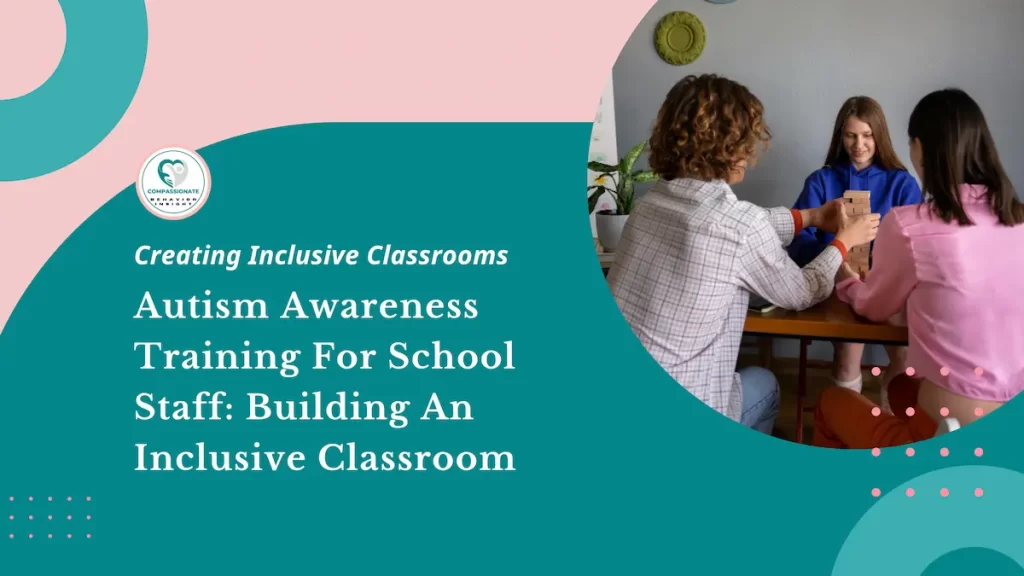
Every school year, public, private, and charter campuses welcome an increasing number of neurodivergent learners into general education classrooms. According to recent public health surveillance published by the Centers for Disease Control and Prevention (CDC), approximately 1 in 36 children is diagnosed with autism spectrum disorder (ASD). While inclusion is the legal and ethical standard in modern education, many teachers, paraprofessionals, and support specialists feel under-equipped to address sensory overload, communication barriers, and behavioral distress.
Campus leaders and special education coordinators searching for autism staff training near me quickly discover that traditional one-hour awareness seminars rarely provide lasting solutions. Passive presentations that merely define autism do not teach an educator what to do when a student runs from the room, experiences sensory dysregulation during transitions, or shuts down during group assignments. To build a truly inclusive school climate, educational teams require practical, evidence-based instruction grounded in Applied Behavior Analysis (ABA).
Investing in structured autism staff training near me bridges the gap between diagnostic terminology and everyday instructional reality. At Compassionate Behavior Insight, led by Board Certified Behavior Analyst (BCBA) Yuri Rivera, we partner with school districts, daycare centers, and charter networks across North Texas. Building upon our foundational guides on classroom behavior management strategies and staff behavior intervention workshops, this comprehensive guide outlines how professional autism training empowers staff and establishes supportive, successful learning spaces for all students.
Table of Contents
ToggleMoving Beyond Awareness: What Genuine Inclusion Demands
For decades, professional development surrounding autism focused primarily on clinical descriptions: defining social interaction deficits, restrictive interests, and repetitive behaviors. While diagnostic awareness is a helpful starting point, general education and special education teachers need actionable behavioral strategies that work in real time.
Surface-Level Autism Awareness Actionable ABA-Grounded Inclusion
Memorizing clinical diagnostic criteria from textbooks. Identifying individual functions of behavior (Escape, Attention, Tangible, Sensory).
Reacting to disruptions with office referrals or loss of recess. Proactively modifying environmental triggers and sensory factors before distress occurs.
Expecting the autistic student to conform to neurotypical norms. Adapting instructional delivery and teaching functional replacement communication skills.
Isolating behavioral management to special education staff only. Unifying general educators, aides, and duty staff through shared response protocols.
When school systems move beyond passive awareness into structured school staff behavior training, educators begin to see that challenging behaviors are rarely willful defiance. Instead, behaviors represent communicative attempts by students whose nervous systems or language capabilities are overwhelmed. Equipping staff with scientific frameworks shifts campus culture from frustration to compassionate competence.
4 Core Pillars of an Inclusive Classroom Framework
Creating an inclusive environment where autistic learners make authentic academic and social progress requires a systematic, four-pillar framework. Clinical standards established by the Behavior Analyst Certification Board (BACB) demonstrate that systematic environmental and behavioral adjustments yield measurable improvements in student engagement.
Pillar 1: Proactive Antecedent Design
Antecedents represent everything that occurs immediately before a behavior takes place. In a school setting, antecedents include noisy transition bells, unclear multi-step assignments, sudden schedule shifts, and crowded hallways. When evaluating options for autism staff training near me, administrators focus on programs that teach educators how to engineer classroom antecedents proactively. Utilizing visual daily agendas, discrete First/Then boards, and pre-correction prompts eliminates the uncertainty that triggers anxiety-driven disruptions.
Pillar 2: Functional Communication Training (FCT)
All behavior is communication. When an autistic student lacks an accessible, immediate way to state that an academic task is overwhelming, they may push their desk over, shout, or bolt from the room. Professional behavioral support training teaches educators to identify the function of the behavior and immediately teach a functionally equivalent replacement behavior. Providing a student with a visual break card, a designated help gesture, or an augmentative communication prompt allows the learner to express their needs safely.
Pillar 3: Sensory-Safe Environmental Engineering
Classrooms are sensory-dense environments. Flickering fluorescent lighting, buzzing air conditioning units, echoes from tile floors, and shifting desk arrangements can overwhelm an autistic child’s nervous system. Staff training guides teachers through environmental audits to identify auditory, visual, and tactile triggers. Simple adjustments like creating a designated quiet corner, offering noise-reducing headphones, and using alternative flexible seating drastically reduce physiological stress.
Pillar 4: Low-Arousal De-Escalation Protocols
When a student enters full neurological overload or an active meltdown, verbal reasoning, lecturing, and disciplinary threats only escalate the crisis. Low-arousal de-escalation focuses on adult emotional regulation:
- Lowering vocal volume and slowing speech tempo.
- Adopting open, non-confrontational body posture.
- Reducing verbal demands to five words or fewer.
- Creating a physical safety buffer without hands-on restraint.
Real Classroom Scenarios: Reactive Discipline vs. ABA Inclusion
To see how specialized training transforms daily school interactions, examine three common educational scenarios observed in K-12 campuses.
| Scenario | Reactive Discipline Response | Proactive ABA Inclusion Strategy |
|---|---|---|
| 1. Unstructured Cafeteria Noise (Elementary Student Overload) | Demanding the student sit quietly or sending them to the main office for disruption. | Offering noise-canceling headphones, a visual lunch checklist, and preferred perimeter seating. |
| 2. Task Avoidance & Material Throwing (Middle School Independent Work) | Issuing disciplinary referrals, assigning zero grades, and giving detention for non-compliance. | Conducting task analysis to shorten problem sets, using high-p sequences, and teaching a break card request. |
| 3. Severe Transition Shutdown (High School Class Change) | Repeated verbal reprimands, threats of tardy penalties, and physically guiding the student. | Implementing visual countdown timers, delivering structured pre-warnings, and enabling early transition passes. |
Scenario 1: Sensory Overload in the Elementary Cafeteria
- The Challenge: A seven-year-old autistic student becomes visibly agitated every day during lunch. The student screams, covers their ears, and begins knocking lunch trays off tables.
- The Traditional Response: Cafeteria monitors give stern verbal reprimands and send the child to the main office, reinforcing the student’s desire to escape the overwhelming room while labeling the child as disruptive.
- The ABA-Trained Response: Staff recognize that the behavior is escape-maintained, driven by auditory and spatial overload. The team provides the student with noise-dampening headphones, positions the student at a quieter perimeter table with familiar peers, and creates a visual checklist showing the steps of lunchtime. The disruptive behavior drops to near zero within two weeks.
Scenario 2: Task Refusal During Middle School Independent Work
- The Challenge: An eighth-grade student throws their math workbook across the room and puts their head down whenever assigned multi-step word problems.
- The Traditional Response: The teacher issues a zero for the assignment and writes a detention slip for property destruction, increasing the student’s academic frustration.
- The ABA-Trained Response: Through targeted behavior coaching for educators, the teacher learns that multi-step reading and math demands trigger immediate cognitive fatigue. The educator breaks the assignment into single-problem increments (task analysis), pairs each completed problem with brief positive praise, and teaches the student to use a desktop “check with teacher” card when stuck.
Scenario 3: Transition Stalling in a High School Setting
- The Challenge: A high school student refuses to leave the computer lab when the period ends, gripping the desk tightly and ignoring verbal prompts, making them consistently late for their next class.
- The Traditional Response: Hall monitors threaten the student with loss of privileges and unexcused tardy records, which leads to verbal aggression and campus security intervention.
- The ABA-Trained Response: Educators recognize that shifting from a preferred digital task to a lecture requires cognitive flexibility. The instructional aide introduces a visual countdown timer at the computer station, delivers a five-minute and two-minute verbal warning, and allows the student to transition sixty seconds before the general hallway rush. The student transitions peacefully and arrives on time.
What Does Autism Staff Training Near Me Include?
Administrators and department heads frequently ask what a comprehensive curriculum for autism staff training near me must address. Effective training is modular, customizable, and practical, blending clinical rigor with everyday classroom application.
Training Module Core Topics Covered Practical Classroom Skills Taught
Module 1: Neurodiversity & Brain Science Neurological foundations of ASD, executive dysfunction, sensory processing profiles. Identifying individual sensory thresholds and debunking behavioral myths.
Module 2: Behavioral Fundamentals The ABC model, four behavioral functions, differential reinforcement principles. Replacing reactive disciplinary punishment with positive reinforcement systems.
Module 3: Space & Routine Engineering Universal design, visual daily agendas, discrete First/Then routines, transition cues. Conducting room audits, reducing sensory friction, and building task momentum.
Module 4: Communication & Replacement Skills Non-verbal communication, AAC device navigation, Functional Communication Training. Teaching functionally equivalent replacement cards, signs, and break requests.
Module 5: De-Escalation & Crisis Protocols Low-arousal verbal pacing, neutral body alignment, personal space buffers, safety. Managing active escalations safely without physical confrontation or power struggles.
When districts invest in classroom behavior management training, teachers gain access to reproducible templates, desktop tally charts, visual schedules, and objective incident documentation tools that satisfy legal IEP and 504 accommodation requirements.
Why Dallas Administrators Prioritize Autism Staff Training Near Me
School districts and charter networks across the Dallas-Fort Worth metroplex operate in dynamic, culturally diverse communities. In urban and suburban campuses throughout Dallas County, Collin County, and Tarrant County, student populations reflect widespread diversity in language, background, and learning needs.
Finding on-site autism staff training near me in Dallas ensures that trainers understand the local educational ecosystem, including Texas Education Agency (TEA) compliance standards, local Multi-Tiered System of Supports (MTSS) structures, and campus-specific scheduling needs.
| CBI Distinct Advantage | Practical School Benefit |
|---|---|
| Clinical BCBA Oversight | Direct program design and delivery by Yuri Rivera, BCBA. |
| 100% Bilingual Capability | Professional development available in English, Spanish, or dual-language formats. |
| Local On-Site Modeling | Hands-on classroom observations, coaching, and live strategy modeling in DFW schools. |
| Full Care Integration | Unified behavioral continuity linking classroom support, in-home ABA, and parent coaching. |
1. Board Certified Clinical Leadership
All training modules developed by Compassionate Behavior Insight are led directly by Yuri Rivera, BCBA. We bring years of hands-on clinical experience working directly with autistic children ages 2 to 14 across North Texas schools, daycares, and homes.
2. Fully Bilingual Staff Delivery in English and Spanish
A significant percentage of instructional aides, cafeteria supervisors, and support paraprofessionals in Dallas-area schools speak Spanish as their primary language. Compassionate Behavior Insight offers 100% bilingual workshops in English, Spanish, or a dual-language format. This ensures that every staff member receives clear, accessible professional development.
3. Sustainable Capacity Building Over Quick Fixes
Hiring an external 1-on-1 crisis aide helps an individual child for a few hours, but it does not empower your permanent educational staff. Securing reputable autism staff training near me builds permanent internal capacity within your teaching team, allowing educators to support multiple neurodivergent learners year after year.
The Measurable Impact: How Training Improves Campus Climate
School administrators must justify professional development budgets by demonstrating a return on investment. Research compiled by the U.S. Department of Education’s PBIS Center shows that schools that implement structured, positive behavioral supports experience significant improvements across key operational metrics.
Performance Metric Measurable Outcome After ABA Staff Training
Office Discipline Referrals (ODRs) 40% to 60% reduction in disciplinary office removals and suspension recommendations.
Instructional Learning Time Restores 3 to 5 hours per week of lost academic instruction per classroom.
Educator Confidence & Retention Significant drop in job-related stress, teacher absenteeism, and mid-year resignations.
IEP Behavioral Goal Mastery Faster mastery of behavioral accommodations and higher fidelity data tracking.
When general educators and paraprofessionals understand how to read student behavior through an ABA lens, campus disciplinary pipelines shrink. Students remain in the classroom where academic growth happens, and administrators spend less time processing paperwork and more time supporting instructional excellence.
Step-by-Step Implementation Roadmap for School Leaders
Bringing high-quality behavioral training to your school campus requires a strategic, phased approach. Administrators preparing to launch autism staff training near me should follow this four-step roadmap to ensure staff buy-in and lasting success.
Step 1: Conduct a Campus Behavioral Audit
Before booking training dates, review your campus discipline data:
- Identify specific locations where behavioral crises cluster, such as cafeterias, playgrounds, hallways, or specific academic blocks.
- Survey instructional staff to understand their primary anxieties when supporting autistic students.
- Review existing Behavior Intervention Plans (BIPs) to identify gaps in classroom execution.
Step 2: Differentiate Training by Professional Role
A one-size-fits-all presentation fails to address role-specific realities:
- General Education Teachers: Focus on universal antecedent modifications, visual supports, and managing group dynamics.
- Paraprofessionals and Aides: Focus on prompting hierarchies, prompt fading, data collection, and physical safety.
- Duty Monitors and Support Staff: Focus on active scanning, low-arousal de-escalation, and non-confrontational communication.
- Campus Administrators: Focus on MTSS alignment, IEP compliance monitoring, and coaching teachers through behavioral debriefs.
Step 3: Combine Workshops with Live Classroom Modeling
True behavioral mastery does not happen in an auditorium. Effective training combines group workshops with on-site classroom walk-throughs where a BCBA models strategies directly with students and provides immediate, respectful feedback to educators.
Step 4: Measure Outcomes and Establish Long-Term Sustainability
Evaluate post-training progress at 30, 60, and 90-day intervals. Track reductions in office discipline referrals, gather teacher confidence ratings, and schedule follow-up booster sessions to reinforce newly mastered intervention techniques.
Frequently Asked Questions (FAQs) for Educators and Administrators
What does autism training for teachers include?
Comprehensive autism training covers the neurobiological foundations of autism, the ABC behavioral framework, sensory environmental engineering, Functional Communication Training (FCT), proactive transition strategies, and low-arousal crisis de-escalation protocols.
How do I choose the best autism staff training near me in Dallas?
When searching for high quality autism staff training near me in Dallas, ensure the provider is led directly by a credentialed Board Certified Behavior Analyst (BCBA) with verified experience in educational settings. Verify that the provider offers on-site classroom modeling, customizable curriculum modules, and bilingual training capabilities if your campus employs Spanish-speaking staff.
Is ABA-based autism training suitable for general education teachers?
Yes. With the majority of autistic learners spending significant portions of their school day in inclusive general education settings, general education teachers need practical tools to structure environments, differentiate instruction, and manage classroom dynamics proactively.
Can training sessions be tailored for daycare centers or early childhood programs?
Early childhood is the most neuroplastic window for developmental intervention. Training programs can be customized specifically for Pre-K teachers, daycare staff, and Head Start educators to build foundational communication, toileting routines, and sensory regulation skills early.
How long does a school staff behavior training workshop take to complete?
Training schedules are fully flexible. Options range from half-day intensive workshops (3 to 4 hours) and full-day campus in-service seminars (6 to 8 hours) to ongoing multi-week coaching series that include direct classroom observations.
Build a Calmer, More Inclusive Campus Today
Creating an inclusive classroom where students with autism thrive is not a matter of luck; it is the result of intentional, evidence-based training and compassionate support. By partnering with an established clinical practice for autism staff training near me, school leaders empower their teachers, protect valuable instructional time, and ensure every student receives the dignity and guidance they deserve.
Whether you oversee a K-12 public school district, a charter network, an early learning daycare, or a private academy in Dallas, expert ABA-grounded training makes a permanent difference.
Help your staff confidently support students with autism. Contact us to schedule a Dallas-area training consultation today.