Managing diverse student needs in modern classrooms requires more than traditional instructional methods. Across K-12 public, private, and charter schools, educators routinely navigate complex behavioral disruptions, task avoidance, and emotional dysregulation. When teachers struggle to maintain a structured classroom climate, student academic progress slows down, instructional time is lost, and educator stress increases significantly.
While one-time professional development seminars offer broad theoretical concepts, they rarely provide the sustained, hands-on support teachers need during active classroom disruptions. To create meaningful, lasting improvements in student achievement, school leaders are turning to individualized behavioral support systems. Implementing structured behavior coaching for educators bridges the gap between academic theory and real-world classroom management.
At Compassionate Behavior Insight, led by Board Certified Behavior Analyst (BCBA) Yuri Rivera, we partner with school districts, early childhood centers, and educational administrators to deliver tailored behavioral support. Building upon our practical guide on classroom behavior management strategies, this article examines how behavioral coaching directly transforms student outcomes, boosts academic engagement, and strengthens overall campus culture.
Table of Contents
ToggleWhat Is Behavior Coaching For Educators?
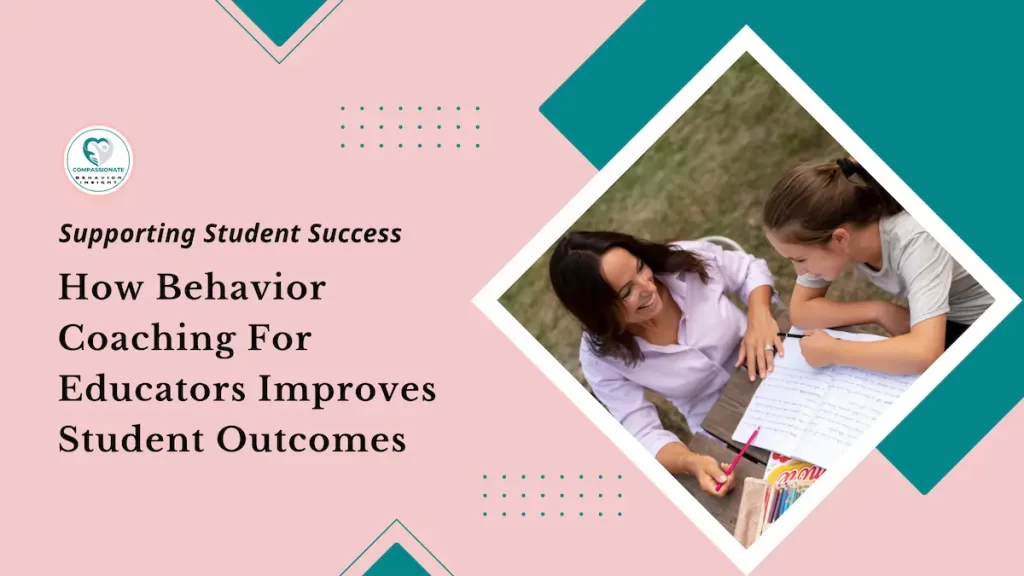
Professional behavior coaching is an active, collaborative partnership between a behavior specialist, such as a Board Certified Behavior Analyst, and an instructional teacher or school team. Unlike static training sessions where teachers listen to lectures in an auditorium, behavioral coaching takes place directly inside the classroom.
Traditional PD Seminars Vs. Behavioral Coaching
Feature Traditional PD Behavioral Coaching
Setting Off-site lecture hall or auditorium setting. Live in-classroom observation and modeling.
Focus Broad theory and non-specific advice. Individualized student & classroom data.
Implementation Teacher attempts execution alone later. Side-by-side modeling and real-time feedback.
Outcome Tracking Rarely measured after seminar completes. Weekly progress monitoring and plan adjustments.
Through evidence-based behavior coaching for educators, teachers learn how to analyze the root causes of challenging behaviors using Applied Behavior Analysis (ABA) principles. A coach observes classroom dynamics, models proactive de-escalation techniques, and provides immediate, non-judgmental feedback. This individualized model helps teachers build practical skills that adapt to their specific classroom environment.
Research-Backed Data: How Coaching Directs Student Success
Investing in professional coaching yields measurable improvements in both academic performance and behavioral stability. Research demonstrates that when teachers receive ongoing classroom consultation, student outcomes improve dramatically across several key areas.
Measurable Student & Campus Outcomes
| Metric / Key Outcome | Impact of Sustained Behavior Coaching |
|---|---|
| Academic Engagement Time | Up to a 30% increase in active learning time due to reduced transition delays. |
| Office Discipline Referrals (ODRs) | 40% to 60% reduction in minor and major administrative discipline referrals. |
| IEP Behavioral Goal Mastery | Higher rate of Individualized Education Plan target achievement in inclusive classrooms. |
| Educator Self-Efficacy & Retention | Significant decrease in stress-related turnover and burnout among teaching personnel. |
1. Significant Increase in Instructional and Academic Engagement Time
Classroom disruptions directly diminish learning opportunities. According to statistical research compiled by the National Center for Education Statistics (NCES), persistent behavioral issues can cost classrooms up to five hours of instruction each week. When teachers implement proactive antecedent strategies through behavior coaching for educators, transition times shrink, off-task behaviors drop, and students spend more time actively engaged in academic instruction.
2. Substantial Reduction in Office Discipline Referrals (ODRs)
Relying on administrative removal, such as sending students to the principal’s office, disconnects struggling learners from classroom instruction without addressing the underlying behavioral function. Empirical data published by the U.S. Department of Education’s PBIS Center indicates that school campuses utilizing structured behavioral coaching experience up to a 60% decrease in overall office discipline referrals. Teachers learn to handle minor disruptions within the classroom environment safely and constructively.
3. Accelerated Target Mastery for IEP and 504 Behavioral Goals
For special education directors, ensuring that students with Individualized Education Programs (IEPs) meet their social, communication, and self-regulation goals is a priority. Clinical guidance from the Behavior Analyst Certification Board (BACB) emphasizes that high-fidelity implementation of Behavior Intervention Plans (BIPs) is essential for student success. Personalized coaching equips teachers and paraprofessionals with the exact prompt-fading and reinforcement tools required to help neurodivergent students achieve their goal benchmarks.
The 4-Phase ABA Behavior Coaching Process
To achieve long-term improvements in student outcomes, behavior coaching must follow a structured, data-driven cycle. The following four-phase process outlines how specialized coaches partner with school teams to transform classroom environments.
Phase 1: Baseline Assessment and Functional Behavior Audit
The coaching journey begins with comprehensive observation. The behavior consultant visits the classroom during typical daily routines to collect objective baseline data. The consultant conducts a preliminary Functional Behavior Assessment (FBA) to identify environmental triggers, task demands, and reinforcement loops that maintain off-task or disruptive behaviors.
Phase 2: Customized Action Plan Development
Using the assessment results, the coach works directly with the educator to establish a realistic, setting-specific intervention plan. Rather than burdening teachers with complex paperwork, the action plan focuses on two or three high-impact strategies, such as visual transition timers, high-probability request sequences, or functional communication cards.
Phase 3: Side-by-Side Modeling and Real-Time Feedback
This phase represents the core difference between passive training and active coaching. During instructional hours, the coach enters the classroom to model newly introduced strategies directly with students. The coach then steps back, allowing the teacher to practice the techniques while receiving discreet, encouraging feedback in real time. Participating in these hands-on staff behavior intervention workshops builds teacher confidence rapidly.
Phase 4: Data Evaluation, Goal Refinement, and Independence Fading
Behavioral science relies on measurable progress. The coach and teacher review weekly tally sheets, interval charts, or duration logs to evaluate whether the intervention is working. As student behavior stabilizes and the teacher masters the techniques, the coach systematically fades support, empowering the educator to maintain long-term classroom harmony independently.
Strengthening Support for Neurodivergent Learners in Inclusive Classrooms
As public and private schools expand inclusive education initiatives, general education classrooms welcome an increasing number of autistic students and learners with sensory processing differences. Without targeted training, educators may feel unprepared to support complex neurodivergent needs effectively.
Inclusive Classroom Support Through Aba Coaching
- Sensory Environment Adjustments: Reduces auditory and visual overload
- Functional Communication (FCT): Teaches appropriate break requests
- Co-Regulation De-Escalation: Maintains low-arousal during meltdowns
- Differential Reinforcement: Celebrates positive replacement behaviors
By providing comprehensive behavior coaching for educators, school systems ensure that teachers understand how to support neurodivergent students with compassion and skill:
- De-Escalation Without Power Struggles: Educators learn low-arousal techniques to co-regulate with overwhelmed students, avoiding punitive responses during sensory meltdowns.
- Proactive Classroom Modifications: Coaches guide teachers in adjusting physical lighting, seating arrangements, and visual expectations to reduce sensory fatigue.
- Prompt Fading and Independence: Teachers learn how to systematically fade verbal cues so that autistic students develop authentic self-advocacy and independent study habits.
When school leadership teams search for specialized autism staff training near me, partnering with a localized BCBA-led clinical practice provides the exact hands-on expertise required to build an inclusive campus climate.
Why Dallas Schools Partner with Compassionate Behavior Insight
At Compassionate Behavior Insight, we believe that every educator deserves compassionate, practical tools to help their students thrive. Headquartered in Dallas, TX, our practice is led by Board Certified Behavior Analyst Yuri Rivera, providing expert professional development and clinical consultation across North Texas.
1. Direct Board Certified Behavior Analyst Oversight
All of our educational training programs are designed and supervised directly by Yuri Rivera, BCBA. We bring scientific accuracy, ethical rigor, and compassionate care to every classroom consultation, adhering strictly to standards established by professional behavior analysis organizations.
2. Fully Bilingual Coaching Capabilities
Dallas-Fort Worth is home to vibrant, culturally diverse communities. Compassionate Behavior Insight offers 100% bilingual consultation and training in both English and Spanish. This ensures that all classroom teachers, instructional aides, and paraprofessionals receive direct coaching in their preferred language.
3. Tailored School Staff Behavior Training
We understand that an urban public high school requires a different approach than a specialized private elementary center or early learning daycare. Our customized school staff behavior training packages are built specifically around your campus demographics, schedule, and behavioral goals.
4. Comprehensive Educational and Family Support
In addition to on-site educator workshops, CBI offers a full suite of services, including individualized in-home ABA therapy and virtual parent ABA coaching. When schools and families use aligned behavioral strategies, children generalize skills faster across home and community settings.
To explore our complete range of clinical options and professional consultation models, visit our comprehensive ABA therapy services hub.
Frequently Asked Questions (FAQs) for Educators and Administrators
How does behavior coaching differ from standard behavioral support training workshops?
Standard workshops typically deliver information to large groups through lectures or slides. While informative, workshops lack individual follow-up. Behavior coaching provides direct, in-classroom observation, individualized feedback, and side-by-side modeling tailored specifically to an educator’s unique classroom setting.
How much time does behavior coaching require from classroom teachers?
Our coaching programs are designed to fit seamlessly into existing instructional schedules without creating extra work for teachers. Observations take place during regular class periods, and brief reflection meetings are scheduled during normal planning blocks or grade-level team meetings.
Can behavior coaching help with general classroom management or only individualized IEP cases?
Behavior coaching supports both universal (Tier 1) classroom dynamics and individualized (Tier 3) behavioral plans. Coaches help teachers establish proactive class-wide routines, positive reinforcement systems, and smooth transition procedures that benefit all students while simultaneously addressing individual needs.
What qualifications should we look for in a professional behavior coach for educators?
School administrators should ensure that behavioral coaches possess advanced credentials in behavioral science, ideally as a Board Certified Behavior Analyst (BCBA) licensed in Texas. Coaches should also have verified experience working within K-12 educational environments and a strong background in positive, assent-based intervention methods.
How can our district schedule a consultation for staff behavior intervention workshops in Dallas?
Getting started is simple. Administrators, department heads, and principals can reach out directly through our website to discuss campus needs, explore coaching formats, and request a customized professional development proposal.
Elevate Educator Confidence and Student Progress Today
Sustained student achievement begins with empowered, confident educators. By moving beyond passive professional development seminars and investing in structured behavior coaching for educators, school administrators can transform classroom climates, reduce disciplinary referrals, and help every student reach their full academic potential.
Whether you oversee a K-12 school district, a charter network, an early learning center, or a specialized private campus in Dallas, expert ABA-grounded coaching makes a measurable difference.
Empower your teaching staff with ABA-based coaching. Schedule a Discovery Call with our Dallas team today.